Microscope-assisted tooth-preserving treatments
Microscopic root canal treatment makes it possible to treat even the smallest root canals of a tooth with extreme precision. It is a precise, safe, and the most comfortable solution for the patient. Using a special dental microscope and modern mechanical instruments, the removal of infected pulp tissue, the cleaning and filling of the root canals becomes more thorough and effective, significantly increasing the chances of saving the tooth in the long term.
Why is microscopic root canal treatment better?
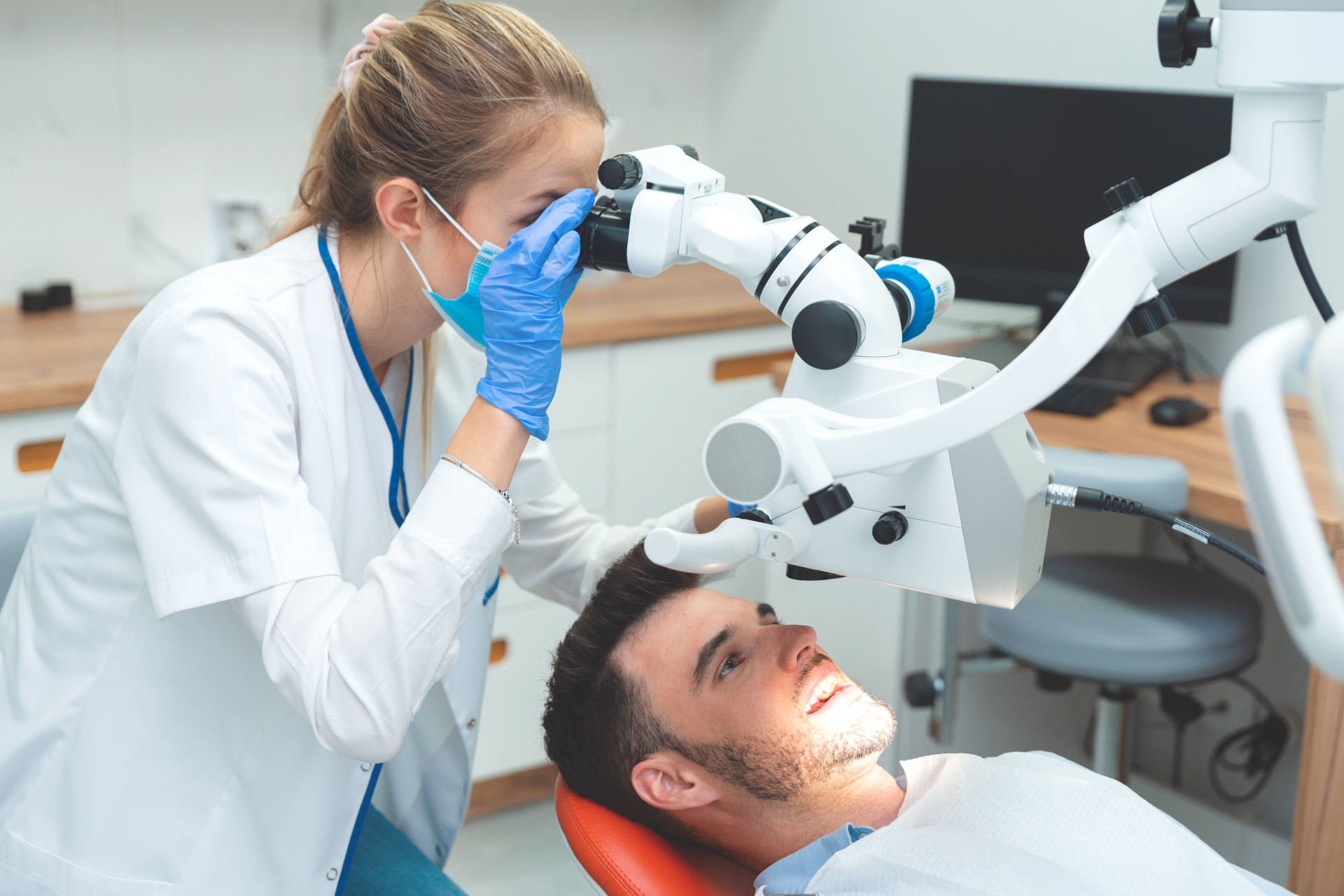
Microscopic root canal treatment is currently the most modern and most accurate method of root canal therapy. During the procedure, a special operating microscope is used to remove the infected or inflamed pulp tissue from inside the tooth and to disinfect the root canals.
This method is more precise, safer, and offers a much higher chance of saving the tooth.
The operating microscope provides up to 20x magnification, which means:
Goal: Preserve as much natural tooth structure as possible while achieving maximum disinfection and cleaning.

Success rate in terms of tooth preservation
Reason for the difference:
Your journey to a radiant smile starts here at Evergreen Dental
We support you during the right steps on the road to more self-confidence
|
Aspect |
Traditional Root Canal Treatment |
Microscopic Root Canal Treatment |
|---|---|---|
|
Accuracy |
Canals are difficult to see, accessory canals may be missed |
All canals and details are clearly visible under the microscope |
|
Success rate |
Average, higher risk of retreatment |
Higher, precise cleaning and filling increase long-term success |
|
Duration |
Shorter sessions but multiple visits, infection may persist |
The procedure takes longer, but no interim treatments are needed, saving time long-term |
|
Risk of infection |
Some canals may be missed, infection may develop |
All canals are thoroughly cleaned and filled, lower risk of infection |
|
Chance of preservation |
Lower chance of saving the tooth |
Higher chance of long-term tooth preservation |
By tooth type
Front teeth
Usually 1 canal, rarely 2. Easy to access and can be treated very precisely under the microscope.
Premolars
Usually 1–2 canals, sometimes 3. They may have branches and connections, which can be safely explored using a microscope.
Molars
Usually 3–4 canals, and very rarely 5–6 due to complex anatomy. Without a microscope, they are almost impossible to treat properly and are located far back in the mouth.
Why is microscopic root canal treatment especially important for molars?
Root canal treatment of molars without a microscope:

The Process of Microscopic Root Canal Treatment
Vital pulp therapy – when root canal treatment can still be avoided
The goal of vital pulp therapy is to preserve the life (vitality) of the tooth – in these cases, the dental pulp is still viable.
Vital pulp therapy is essentially an umbrella term that includes conservative treatments aimed at maintaining the health and vitality of the dental pulp. During the procedure, the living tissue is protected with special biomaterials. Using microscopic magnification, everything is performed with exceptional precision, so the tooth is treated only to the necessary extent.
As a result, the tooth remains healthier and stronger, and can better withstand long-term chewing forces – which is especially important for molars.
This treatment can also be applied to deep but still vital, even symptom-free, decayed teeth. The exact possibilities are always determined by a dental examination and X-ray.
Early intervention is key: the sooner the patient arrives, the greater the chance of saving the tooth.